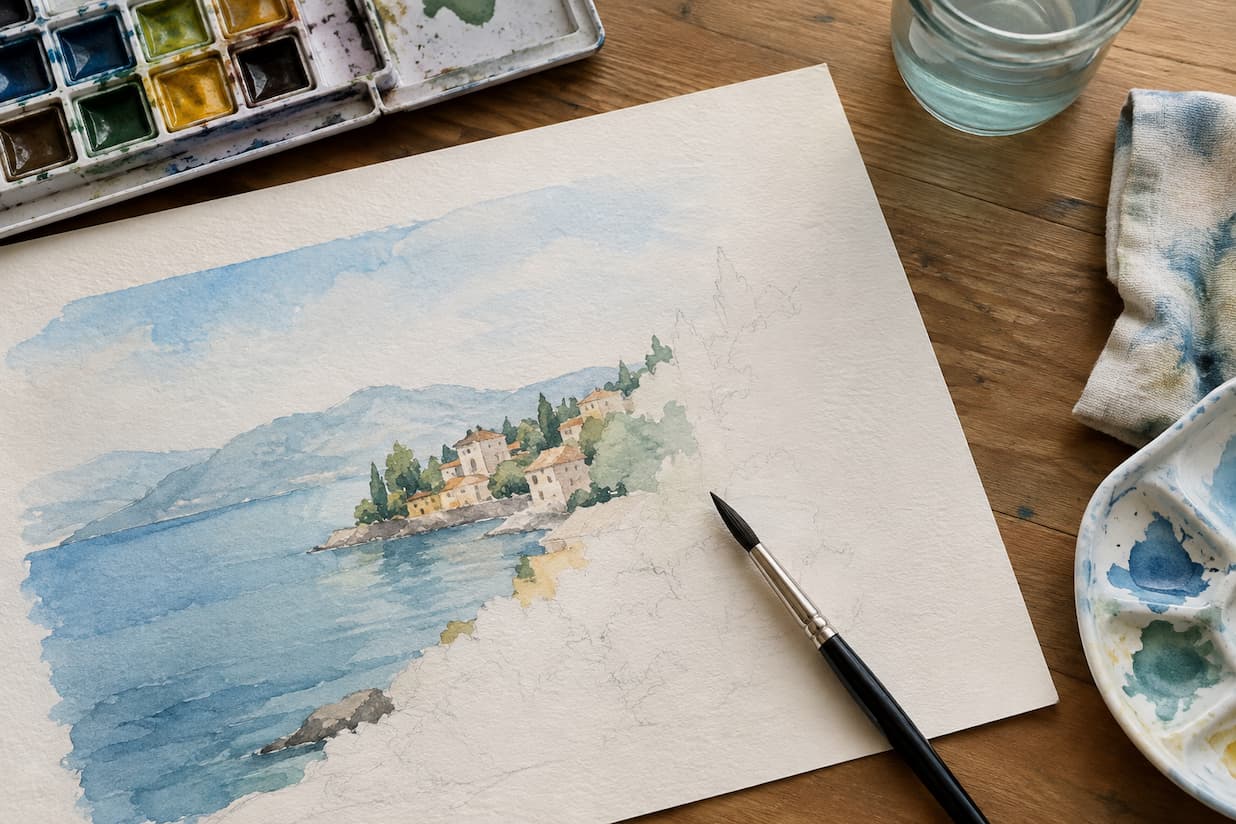
Want to start painting with watercolors but don’t know what to buy first? Here you’ll find the basic watercolor materials you really need, without spending money on things you won’t use.
Watercolor painting requires less equipment than you might think, although it’s worth choosing the essentials carefully. With these five items, you can sit down and paint your first piece:
If you had to invest more in just one material, it should be the paper. Good watercolor paper absorbs water evenly, withstands several layers of paint and prevents the sheet from buckling or tearing when wet.
That’s why regular drawing paper or printer paper isn’t suitable for watercolor painting. It wrinkles, the colors lose their brightness and washes come out uneven. Buying paper specifically designed for watercolor from the very beginning is well worth it.
Paper weight refers to the weight of the paper and, in practice, its thickness. For practice and testing, 200 gsm is enough, but for finished artwork, 300 gsm is the usual choice because it can handle a lot of water without becoming badly distorted.
With lighter weights, such as 150 gsm, you’ll need to tape the edges to a board to prevent the paper from buckling. It’s not impossible to work this way, but it makes things more complicated when you’re learning.
Paper grain refers to the texture of the surface and affects how the pigment settles. Hot-pressed paper is smooth and allows for precise marks, cold-pressed paper has a moderate texture and is the most versatile, while rough paper has a pronounced texture that creates a highly expressive finish. For beginners, cold-pressed paper is the safest choice because it is forgiving and works well for almost any subject.
A four-sided glued watercolor block is very practical because the paper stays in place while you paint and you don’t need to stretch it. It’s the most convenient option if you’re just starting out.
Loose sheets are cheaper per sheet, although they require tape and a board. Watercolor sketchbooks, meanwhile, are perfect for taking with you when painting outdoors.
If you’re unsure, an A4 or A3 watercolor block is a good middle ground. It gives you plenty of space to practice without being so large that you’re afraid of ruining a sheet.
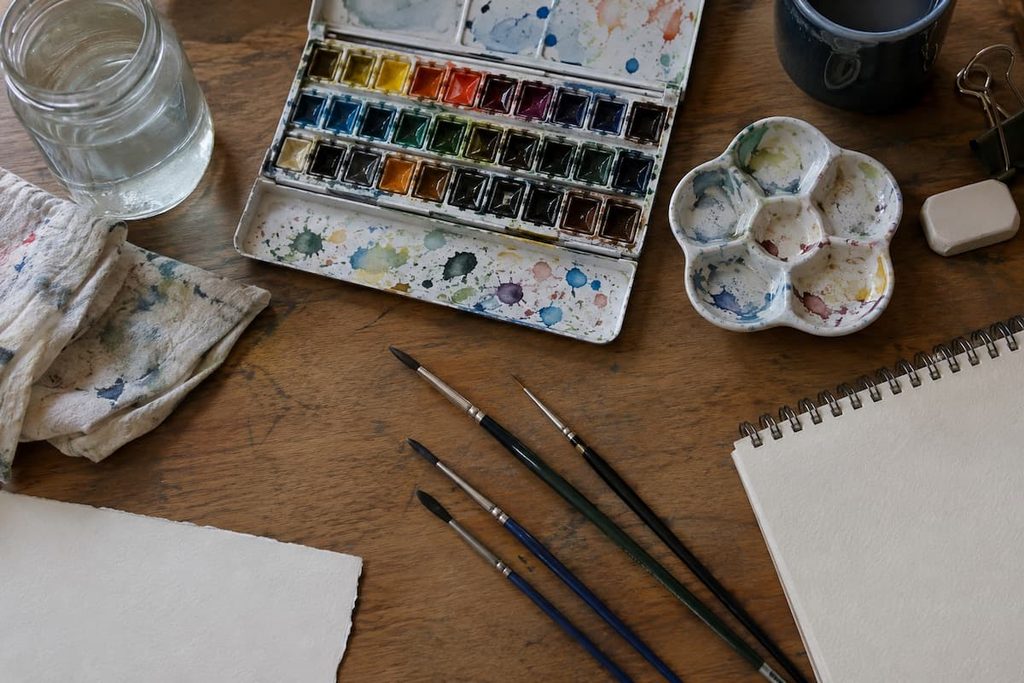
Watercolor paints are mainly sold in pans and tubes, and both formats are perfectly valid. The difference comes down to convenience, the type of work you want to do and your budget.
Watercolor pans are often sold in sets with a built-in palette, making them ideal for beginners and for painting away from home. Simply wet them with your brush and start mixing.
Their main limitation is that it can be harder to pick up a large amount of pigment at once. This becomes noticeable when you want to cover large backgrounds or paint broad skies.
Tube watercolor has a creamier consistency and allows you to prepare concentrated pools of color on your palette, which are ideal for large washes. They can be used up quickly if you squeeze out too much, but a single tube can last a long time. Many painters combine both formats: tubes in the studio and pans when painting outdoors.
Student-grade paints cost less and contain a lower concentration of pigment, while artist-grade paints offer more luminous colors and better lightfastness. For learning, student-grade paints are more than enough.
If you later decide to sell or frame your paintings, it’s worth moving up to higher-quality pigments. This helps prevent the colors from fading over time.
A limited palette teaches you how to mix colors and gives your paintings greater harmony. With lemon yellow, yellow ochre, carmine red, ultramarine blue and cyan blue, you can create almost any color you need. If you want to expand your palette slightly, add burnt sienna and a general-purpose green.
You don’t need white or black paint to get started. In watercolor, white comes from the paper itself, while a rich dark can be created by mixing ultramarine blue with burnt sienna.
You don’t need a huge collection of brushes to get started. Three or four well-chosen brushes can cover almost everything you’ll paint during your first few months.
Natural-hair brushes, such as kolinsky sable brushes, hold a lot of water and have an excellent point, but they are expensive. Synthetic brushes are more affordable, durable and perfectly adequate for learning, while mixed-hair brushes combine the advantages of both at an intermediate price. For beginners, a good-quality synthetic brush is the most sensible choice.
You don’t need more than four brushes to start. This selection covers everything from fine details to large washes:
A palette with wells or a smooth ceramic surface works well for mixing colors without contaminating them. White plastic palettes are inexpensive, although they can sometimes repel water and cause the paint to bead up. If this happens, wash the palette thoroughly with soap and the problem will usually disappear.
You should also prepare two water containers: use one to rinse your brush and the other for clean water when diluting paint. It’s a simple detail, but it prevents your colors from becoming muddy and losing their brightness.
There are a few small tools that aren’t essential but can make a big difference in comfort and results. You may already have many of them at home, or they cost very little.
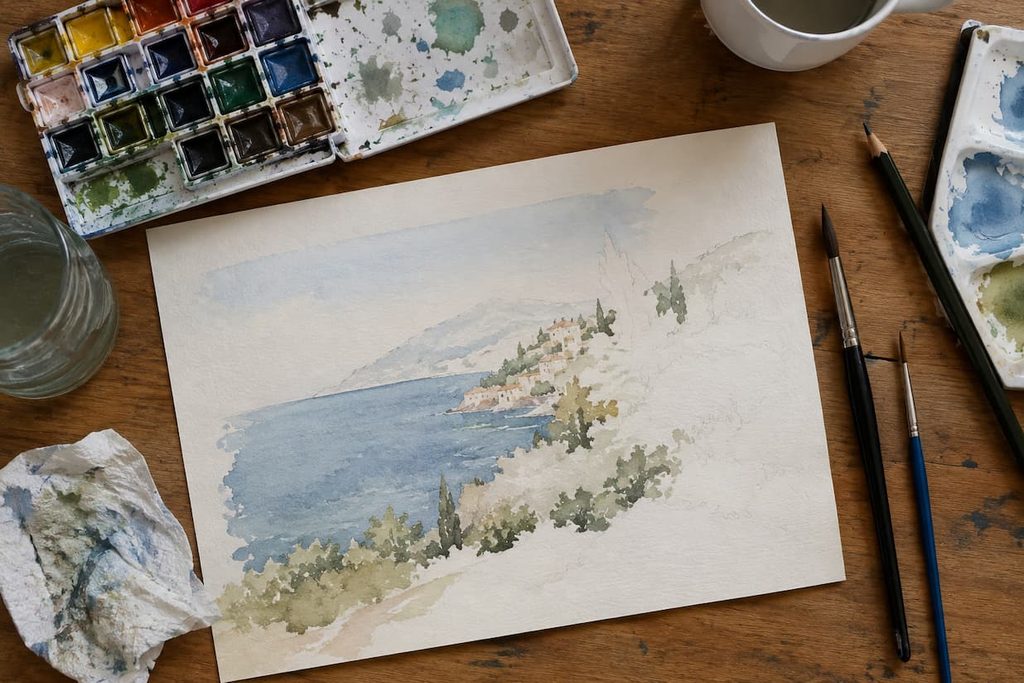
A beginner’s kit with a watercolor paper block, a student-grade pan set, three brushes and a few accessories will usually cost around €30–€60. You don’t need to spend more to learn the fundamentals.
If you need to prioritize, invest first in the paper, then in the brushes, and leave artist-grade paints for later. Poor-quality paper can ruin even the best paint, while good paper can make even an affordable paint set look much better.
The most common mistake is starting with low-weight paper or a regular drawing sketchbook. The result can be frustrating: the paper buckles, the paint spreads unpredictably and it’s easy to think that you’re the problem.
Another common mistake is buying a huge 48-color set. With a limited palette, you’ll learn to mix colors faster, your paintings will look more harmonious and you’ll spend less money.
It’s also worth avoiding stiff brushes designed for oil or acrylic painting, as they don’t hold enough water or form a good point. Always check that the label says the brush is suitable for watercolor.
Wash your brushes with lukewarm water and mild soap after every session, and let them dry horizontally or with the tip pointing upward. Storing them with the bristles facing downward can deform them over time. You should also let your paint pans dry before closing the case, and store your paper flat and away from moisture.
Once you have your kit ready, spend your first sessions practicing washes, gradients and color mixing on test sheets. Without the pressure of creating a good finished painting, you’ll gradually get a feel for how water and pigment behave, which is one of the hardest things to control at first.
Once you’re comfortable handling your materials, the next step is learning the basic watercolor painting techniques, such as wet-on-wet and wet-on-dry. And if you’d like to see what the finished result can look like, you can take a look at the original watercolors available in the shop.